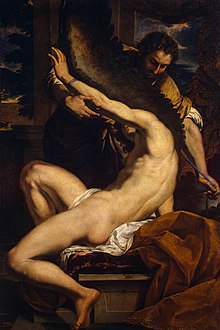
 Daedalus and Icarus, c. 1645, by Charles Le Brun (1619–1690)
This essay by Katalin Balog first appeared at 3 Quarks Daily. Reprinted with permission.
In the past, when I asked students if they would want to enter the Experience Machine – a fictional contraption thought up by the philosopher Robert Nozick – they would generally say no. In the Experience Machine, one would have virtual experiences: for example, of a life blessed with mountains of pleasure, great love, monumental achievements. But one would lose touch with one’s actual life. My students did not want to leave their actual lives behind. In the last few years, things have changed. Most of them now proclaim their readiness to ditch it all for the virtual pleasures of the Experience Machine.
My students’ recent eagerness for the virtual is a symptom of our culture’s alienation from the world. During my life, I have witnessed the slow but unstoppable advance of commodification and technology, which has brought us to the threshold of escape from the world – certainly in fantasy, but perhaps in reality, sometime soon.
1 Consuming Experiences
When I was young in my native Budapest, we – my family and friends – didn’t think of life in consumerist terms. We couldn’t, as it was communism, and there was not much to consume – but in any case, the idea of collecting pleasant experiences seemed frivolous and alien. Beautiful Budapest was run down, its buildings still showing bullet holes decades after the war. Tourists didn’t crowd around its “attractions”. It was our city. Sure, we listened to music and attended plays, there were parties where everyone wanted to be, we bought ice cream and cakes, but we didn’t make a habit of maximizing pleasurable, beautiful, or edifying experiences; we didn’t have a plan that would ensure the best results. Much was left to chance and improvisation, as life in those days was hard-scrabble, and things could – and often would – go wrong. Everyday necessities were sometimes hard to obtain, and we had to stand in line a lot. People were generally rude and wielding whatever little power they had in a hostile manner. Our goal was just… to live our life and have the experience that comes with it. But we were also not fazed or annoyed by unexpected obstacles in the way a more committed consumer or tourist would be. Of course, some people I knew went skiing and climbing in remote and beautiful places; that was a thing one could do as well. But most of the time, normal people did normal things, and that was our life. Communism, for a while at least, constrained the consumer in us. I am not idealizing this state of affairs – I was in the underground resisting the oppression that maintained it; just pointing out the difference it made in our attitude to life.
I noticed the contrast between this and what was normal in the West especially clearly when, after moving to New York, I was already between worlds. My mentality was not quite like the communist-era girl I used to be, but still, I haven’t fully acculturated to Western ways either. A friend of mine visited from Holland while I was back home. We decided to go to one of the baths, one that I often went to as a child and later as a young adult. I didn’t quite remember which tram stop to get off at but thought we would work it out as we go. I missed the stop, and my friend was shocked that I didn’t have a plan ahead of time and that, as a result, we “wasted our time,” having to retrace our steps. I was confused. Weren’t we together, living our life? Is that really time wasted? But I understood her point of view: only certain things count as bona fide life: the worthwhile moments one plans ahead to have. Being a consumer, which I had already started becoming, one is encouraged to view only the moments of fruition, the consummation of one’s goals as really part of one’s life; the rest is mere getting there, with all the annoying friction that entails. I started to live more like this, though I could still see that something was not quite right about it. In Out of the Silent Planet, C.S. Lewis cautions about this attitude: choosing one good or pleasure over another, or hoarding pleasures is not a good thing, it is a temptation from the Evil One…
Seeking out worthwhile experiences has its use. But there is a heavy price to pay. These days, Budapest is absolutely overrun by tourists, like every beautiful city in the world. The world now resembles prepackaged slices of cake that everyone is encouraged to gorge on. Precious art is hard to see from hoards of selfie-taking tourists seemingly not very moved by the sights on offer. Nature itself is commodified. I recently visited Plitvice National Park, a picture-perfect tourist attraction. Though it was really beautiful, there were swarming crowds, and everything was manicured. I felt the world veiled, distant, inaccessible. It brought to mind a short story by Géza Ottlik about a famous conductor in a midlife crisis visiting his hometown. After much struggle and malaise, he finally takes a long, aimless walk and suddenly sees shards of light reflecting on a familiar building, thinking: “I have been in many places, I have seen the light reflected on the wall on …. street, I have lived.” Visiting Plitvice does not give one this sense of deep life.
As a result of consuming the world, experience is becoming more shallow. The more you manage experience, the more you lose connection to it, which seems like a paradox. Here is Dostoevsky, in Winter Notes on Summer Impressions, in a particularly sardonic passage:
The bourgeois’s other legitimate and equally strong need is to se rouler dans l’herbe. The fact is that as soon as a Parisian leaves town, he loves, and even considers it his duty, to lie on the grass for a bit; he does it with dignity and the feeling that he thereby communes avec la nature, and is particularly delighted if someone watches him at it.
Consumption now is the default experience of the world. I remember the first day the Oculus opened at World Trade Center. I was able to walk through it; it was scarcely populated, with no commerce, just a glorious commuter station. It was uplifting, wonderful, its pristine white spaces splashed generously with light. Now I often cringe walking through. It has become just another mall, made even more obvious by the “artistic experiences” offered to the commuting public. There is nothing wrong with business itself; it just feels there is nothing anymore that is not under its regime. In the process, we’ve sacrificed silence and a direct connection to the world.
2 Technology and the Vivid Unknown
The commodification of the world is just one cause of our alienation from it. Another is technology which ever more rapidly changes both the natural and man-made environment. In Koyaanisqatsi, Godfrey Reggio documents this change: the film opens with slow motion and time-lapse footage of majestic, vast, unspoiled landscapes. It invites loving attention to the experience of cloud, water and mountain. The rest of the movie is filled with skyscrapers, the mad rush of the city (in quick motion), airplanes, demolitions, urban decay, and a mushroom cloud. Jarring scenes of giant machines and environmental degradation are set to an ever-accelerating soundtrack by Philip Glass.
Alienation from nature is painful. I once visited a technology museum in Munich. It had many engaging and fun exhibits. But the overall impression I carried away from it was the relief when we finally left. Inside the museum everything was plastic, metal and glass, everything shaped to be useful and organized efficiently. As we walked through the exhibit, it dawned on me that there is nothing organic here except human beings. I was imagining hell to be furnished like that.
Koyaanisqatsi has been recreated by John Fitzgerald. His project, The Vivid Unknown, was recently shown at TECHNE at BAM. It is an AI-assisted video installation trained on the original images and soundtrack. The difference is, this time, the magnificient – digitally rendered – landscapes are very quickly giving way to scenes of the human technological environment. Even when nature returns, the cuts are too fast and jerky for the eye to linger on anything. It is as if the film suggested that in the intervening 40 years, our alienation from nature has become irreversible. What’s more, as it also demonstrates, our attention now is not even on the man-made physical environment; we are absorbed in the digital. The Vivid Unknown offers interaction to spectators. When they stand in front of the screens, their shape sometimes appears as a shadow in the landscape, sometimes as an outline filled with jumbled, Dadaist fragments of the landscape while the landscape itself disappears. Spectators don’t just spectate; they can force themselves on the landscape. Some people recorded the video screens to create digital memories of their encounter with the digital.
People are warming to this new world, judging from the phenomenal success of the recent ABBA concert in London, where digital avatars of the four young singers from 50 years ago “perform” for an audience reportedly brought to tears from the experience.
Technology doesn’t just alienate people from nature. Digital technology, in particular, though wonderful in many ways and has the potential to feed the soul and deepen inner life, has actually made quiet attention to anything very difficult. There is a nadir of contemplation in contemporary life. The commercial interests behind digital media – especially in the case of social media, but also probably soon AI and virtual reality – ensure that we are ever more enmeshed in and dependent on digital media, and our attention is ever more fully captured by them. The commodification of experience and the digital saturation of daily life reinforce each other in a feedback loop. The resulting forms of life make serious contemplation of one’s experience – without which not much seriousness can be expected on any front – very difficult. Without contemplation, our connection to reality becomes tenuous. This prepares the way for the great escape. Having lost our grounding in terra firma, we are ready for – as the creators of The Vivid Unknown put it – “terra techno firma”.
3 The lure of the virtual
Ready or not, AI is here, and possibly life-like VR is also on the horizon. The Experience Machine, which used to be considered entirely hypothetical and not really serious, like invisibility rings and the like, has become a matter of practical concern. Techno optimists like Andy Clark and Dave Chalmers think all these technologies are a good thing; though there is also much hysteria, fear, and trepidation about the dangers and drawbacks. I will talk about these in a different post.
People, like my students, who feel ready to leave their actual lives behind, might well be alienated – as I have argued we all are to some degree. But there is another impetus behind it, too – and this one is as old as human culture. It is the desire to transcend human limitation. Humans have dreamt of acquiring extra senses – to be able to sense like a bat, a bird, an octopus, or like a god. They have dreamt of immortality – which some techno-optimists think will come soon, and various religions have sanctioned as fact. Sudden breakthroughs in AI promise transcendence in all these ways. But there is a warning, too, that runs through history. Icarus wanted to fly away from captivity, and his unfortunate father Daedalus assisted him, but Icarus’ wings were melted by the sun, and he only succeeded in crashing into the sea.

Virtual alienation is a facade.
If anyone is curious, see my comments on Michael Labossier’s blog, regarding Hume and induction. The expose on Hume might be interesting for the uninitiated. My remarks are just me.
Uh. The vivid unknown does not exist. Unknownness is never vivid—it is dim. Seems to me…
Ms Balog covered a lot of ground in this essay. Her sweeping overview is spot on.
Our disconnect from the natural world, the immersion in a commodified consumer society, and the always quickening pace of everything.
I confess, during my working life, and still as a retiree, I am ALWAYS aware of the clock…..not the enjoyment of the passing of time, but rather just what time it is. It detracts from being able to enjoy and lessens the chance of stumbling onto a transcendent experience, because I am always watching the clock, timing the experience.
The advances of technology have changed our relationships with each other, and even ourselves. What do I do if waiting for something/someone for just a few minutes? I scroll through my smart phone. Never allowing myself the quiet of inactivity. I suspect it is so for many others.
It is a self-imposed price we pay for our 24/7 digital ‘surround world’.
Due to family and circumstance I know many people who grew up and were educated in a former “eastern block” nation. Combining those personal relationships with reading, I have gathered that many people living a politically oppressed life, while also lacking the consumer abundance available just to their west, developed deep internal lives and intense personal relationships. (although these types of friendships tended to be few in number) What Ms Balog wrote, coming from pre1989 Hungary, matches quite well.
I also loved her observation that “the more you manage experience, the more you lose connection to it…”. So true. As my earlier reference to time tried to say, the more we force things by self-management, the less likely for something natural to ensue.
Virtual; being such in essence or effect.
“During my life, I have witnessed the slow but unstoppable advance of commodification and technology, which has brought us to the threshold of escape from the world – certainly in fantasy, but perhaps in reality, sometime soon.” Katalin Balog
The only escape from reality is into delusion, delusions are attractive, we are surrounded by deluded people, probably including ourselves, we can live delusion-ally as long as the reality that underpins our lives continues to supports us.
In my life I have also seen a lot of changes, I was born in nineteen thirty nine, so I saw the tail end of the horse era and the beginning of the paved road, the community where I was born had about five thousand inhabitants and was self sufficient in many respects, most of the food we ate was raised within twenty-five miles of the town, the super market hadn’t yet appeared and people could still make a living with a small grocery store, everybody knew everybody else, perhaps the greatest single change is that people don’t know each other anymore.
We had the movies of course, and although we knew they weren’t ‘real’ they had ‘virtually’ the same effect as if they were real, perhaps real but in a different context of reality. I, as a child, crossed the Pacific fighting from island to island with John Wayne the Marine Colonel and Patricia Neal the head Nurse of the hospital, I guess they loved each other but as the Colonel said; in his gruff voice, we got lots of Japs to kill before we can think about ourselves.
I’ve read recently that the first clocks began to appear on the outside of buildings in the sixteenth century so this was the beginning of the conditioning of people to conform themselves to the dictates of machines. The people who invented and built the clocks had no idea they were doing that, so where did the impetus to build the clocks come from? What is intelligence really?
I believe that nature is the fount from which the intelligence that manifests its self in the living creatures, including the humans, flows, where did nature come from? as for the purpose of life? perhaps purpose and meaning are human concepts that have no corollary outside our minds.
Species come and go, the Trilobite once dominated the world, the trilobite was distinguished from any other creature that has, so far, ever lived, by having crystal eyes, you can still see light shining through their eyes. Mankind is distinguished by its ability to recognize it’s own uniqueness, other than that we just follow our impulses as we struggle to dominate the other humans and nature it’s self, this is neither good nor bad, this is an observation, this is just how things really are!
We are an evolutionary creature, I was born into the reality of 1939, if I was born in 2025 my experiences would be much different, Fifty years from today much different again, are these changes making us stronger, better able to face the challenges that have always appeared, or are they weakening our ability to respond appropriately?
Of course I don’t pretend to know the answers to these questions, perhaps someone else does?